112 wins, 4 losses, 14 trophies, 17 years
Those are the numbers. They do not fully communicate the reality. Rafael Nadal first won Roland Garros in 2005 when he was 19 years old. He last won it in 2022 when he was 36. The gap between those two dates is 17 years. He was still winning the French Open when players who idolized him as teenagers were losing to him in the semifinals. No athlete in any major professional sport has maintained that level of dominance at a single event for that long.
To understand why requires understanding both what the clay court at Roland Garros is and what Nadal's game was built to do to it.
What the clay does
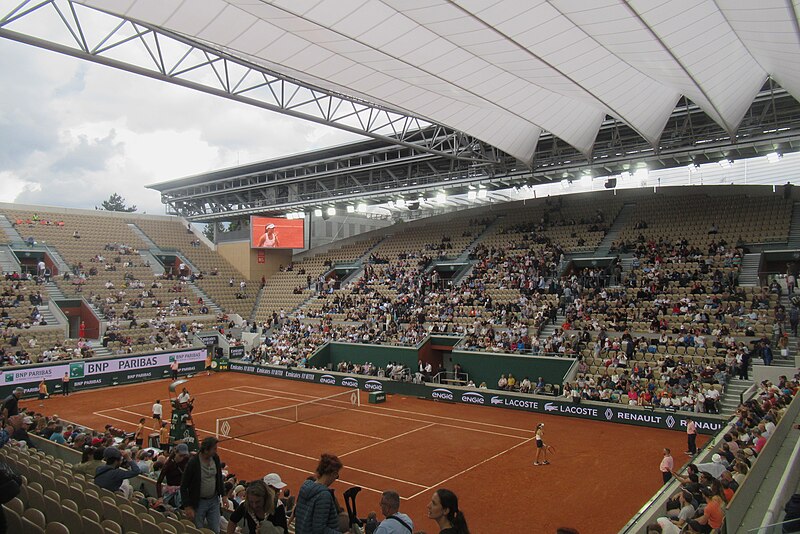
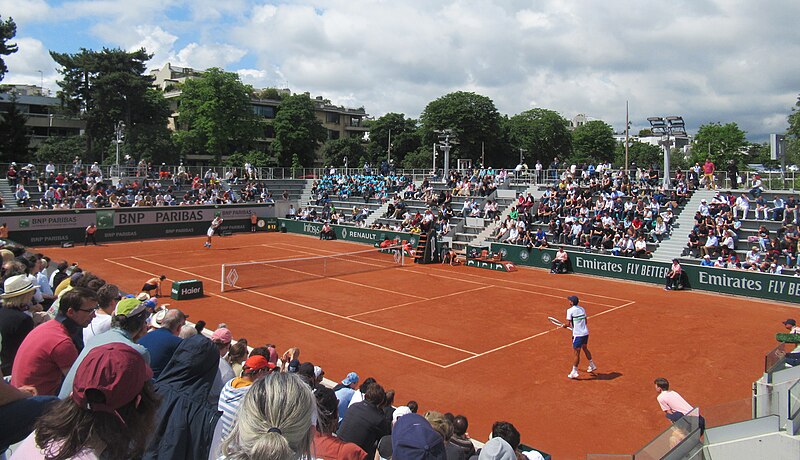
Roland Garros uses crushed red brick from northern France, compacted into a surface that slows the ball by roughly 25 percent compared to hard courts and raises the bounce significantly above what players see anywhere else. A heavy topspin shot that skids through at waist height on a hard court sits up at shoulder height on clay. This is the fundamental tactical fact of the tournament. Players who generate extreme topspin benefit disproportionately because the clay amplifies it. Players who rely on pace and flat hitting suffer because the clay absorbs it.
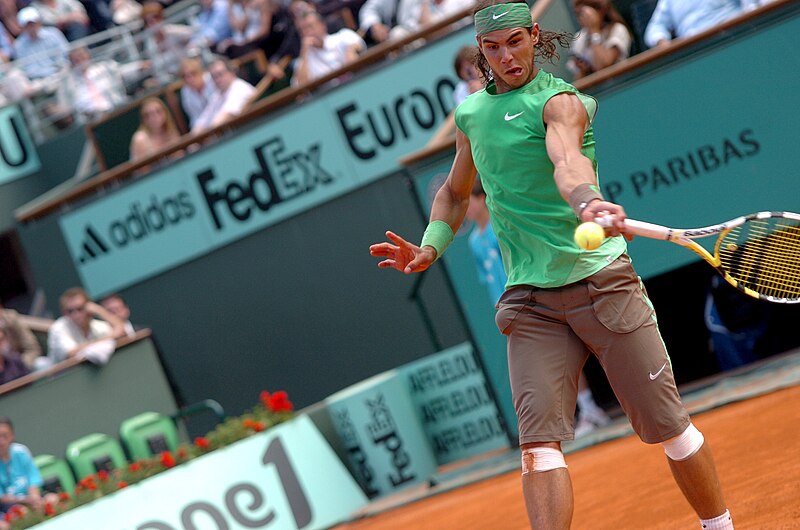
Nadal generated somewhere around 4,900 RPM on his forehand. Roger Federer, for comparison, generated around 3,200. That gap sounds technical. What it means in practice is that Federer's shots, which were devastating on every other surface, were significantly less damaging on clay. Nadal's shots, already effective elsewhere, became genuinely punishing on clay because the surface amplified the kick and pushed the ball above where most players could hit it aggressively.
Add to that Nadal's left-handedness, which sent his serve curling away from right-handers in a direction they were unaccustomed to defending, and his extreme defensive depth, which allowed him to retreat 10 feet behind the baseline and still construct winners from positions most players would concede the point from. The result was a player whose game was optimized for clay in ways that were probably not entirely intentional but were completely comprehensive.
The run
Nadal won his first Roland Garros in 2005 without losing a set. He was 19 years old and had never played at the highest level on a major clay court. He beat Puerta in the final and cried. What looked at the time like a promising debut turned out to be the beginning of the most extraordinary run in the history of Grand Slam tennis.
He won again in 2006, 2007, and 2008. The 2006 final against Federer ended 6-1, 6-1, 6-4. The 2007 final ended 6-3, 4-6, 6-3, 6-4. The 2008 final ended 6-1, 6-3, 6-0. Federer lost in the final to Nadal four times between 2006 and 2011 and never won. He finally won Roland Garros once, in 2009, and only because Robin Soderling had knocked Nadal out in the fourth round weeks earlier. Without that upset, Federer's career Grand Slam — one of the most storied achievements in tennis history — does not happen on that timeline.
The first loss came in 2009. Soderling, ranked 23rd, ended a 31-match winning streak at Roland Garros that had lasted four years. Nadal was dealing with knee problems and had clearly lost something that year; he also lost Wimbledon later that summer. But what happened next is the thing that separates Nadal from every other athlete at every other event: he came back in 2010 and won without losing a set. He came back in 2011 and won. And 2012. And 2013. And 2014.
The Djokovic question
From about 2011 onward, the interesting storyline was not whether Nadal would win but whether Djokovic could stop him. Djokovic was arguably the better player in that period. He held the world number one ranking for longer, won more majors total, was more versatile across surfaces. On clay, though, Nadal was something else. Djokovic finally beat him at Roland Garros in 2015 (7-5, 6-3, 6-1) — one of the most dominant wins over Nadal that anyone managed on clay, ever — and that loss effectively ended Nadal's second great Roland Garros run. But even then, Nadal came back. He won in 2017. He won in 2018, 2019, 2020, and then one final time in 2022 when nobody expected it.
The 2020 final deserves its own mention. Djokovic was the world number one, arguably playing the best tennis of his life, and Nadal beat him 6-0, 6-2, 7-5. Djokovic, 33 years old, one of the greatest players in history, was bageled in the first set of a Grand Slam final. By Nadal. At Roland Garros. In 2020. The year Nadal turned 34.
The records in context
Bjorn Borg won six Roland Garros titles and remains the previous benchmark for clay dominance at the French Open. Borg lost three matches there across his six titles. Nadal lost four matches. Borg won his six titles in seven years between 1974 and 1981. Nadal won 14 titles across 17 years, never winning in years where he withdrew injured (2004, 2016) and never losing in a final.
That last part deserves repetition: Nadal was 14-0 in Roland Garros finals. He never needed a fifth set to win a final. He won four titles without dropping a single set across the entire tournament. If you built a simulation and tried to design the most complete record at a single Grand Slam, you would not design something this complete.
Pete Sampras won 14 Grand Slams across his career and zero Roland Garros titles. He reached the quarterfinals once, in 1996. Sampras was the dominant player of his era on every surface except clay, where Nadal's predecessors and contemporaries proved equally capable of neutralizing his serve. Nadal is the counterpoint to Sampras: a record defined not by breadth but by absolute depth at one place.
What Alcaraz inherits
Carlos Alcaraz said, after his 2024 Roland Garros title, that Nadal showed him the way. That Nadal is the reason he fell in love with that court. Alcaraz grew up in Murcia, 200 miles from Nadal's hometown in Mallorca, and watched Nadal win Roland Garros as a child. The forehand he built, heavy with topspin and optimized for clay, is not accidental. The defensive depth, the willingness to run down balls that opponents have already written off — these things are studied.
Whether Alcaraz can build anything that challenges what Nadal did is genuinely unknowable. What is knowable is that Nadal's record is not going to fall easily or quickly. Fourteen titles at a single Grand Slam in the professional era, with a 97 percent win rate, over 17 years. That number exists in its own category.
Casper Ruud, who lost the 2022 final to Nadal at age 36, said it best: "Playing against him at Roland Garros is like playing against God on his home court."
Last updated: September 2026
Inside this Tournament
Latest news, related guides, and the data behind The 14 Titles That Will Never Be Matched: Nadal's Roland Garros Story.