Somewhere in Beijing this afternoon a nineteen-year-old will walk out for a semi-final, and nobody in the building will think of her as young.
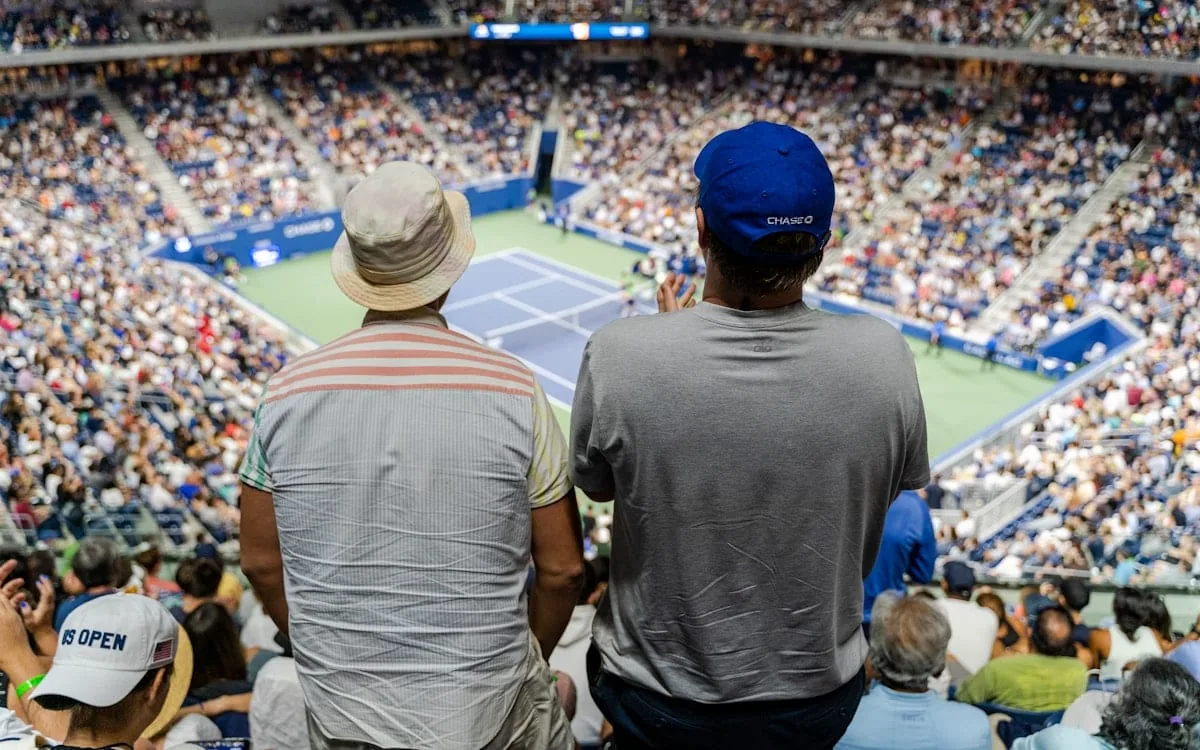
That is the strange thing about Mirra Andreeva now. She is still, by any sane measure, a teenager playing adult sport. She was nineteen in April. She has a Grand Slam title, four WTA 1000 semi-finals, a seat at the season-ending championships and a ranking inside the top five, and she has collected all of it before most people her age have finished deciding what to do with themselves. And yet when she comes out to play, the reaction in the stands is not the indulgent noise crowds make for a prodigy. It is the flat, respectful quiet that greets someone expected to win.
She got there quickly and she got there quietly, which in tennis is almost a trick. Nobody built a marketing campaign around her. She did not spend two years as a promising thing. She simply kept turning up, and at some point in the last eighteen months the sport stopped grading her on a curve.
A Saturday that nobody planned
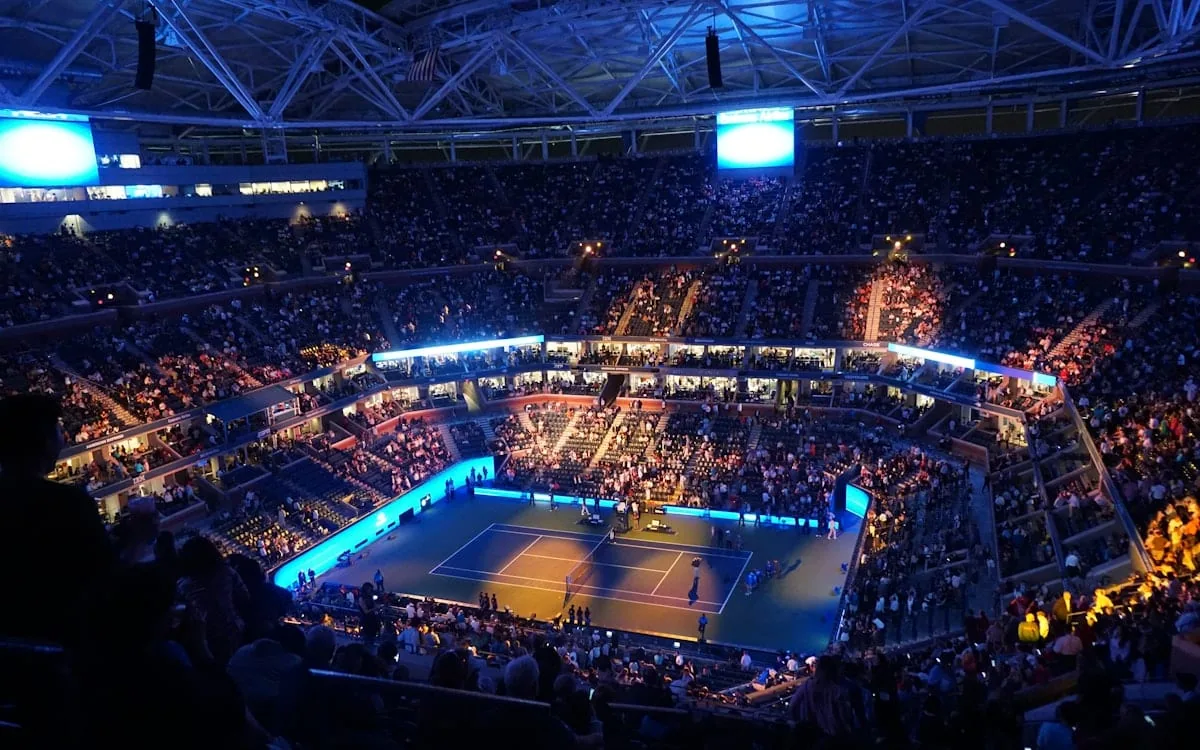
Today is the semi-final day of the China Open, the tournament that has been running at the National Tennis Center in Beijing since the end of September and finishes tomorrow night. If you watched the first week of it, you already know what that place looks like under lights: a stadium shaped like a cut stone, blue court, a crowd that stays late and knows exactly when to make noise.
Andreeva arrived in the last four the hard way. She dropped a set to Yue Yuan in the first round and then did not drop another, beating Polina Kudermetova, then Daria Snigur for the loss of four games, and then Ekaterina Alexandrova in a quarter-final that took an hour and fifty-three minutes and went to two tie-breaks. She had never beaten Alexandrova before. She had been down a break in the first set and had served for the match in the second and been pulled back. She won it anyway, 7-6, 7-6, which is a sentence that will mean something to you if you have ever watched a player of that age lose exactly that kind of match.
Her semi-final is against Nikola Bartunkova, a Czech seeded twenty-sixth who has spent this fortnight dismantling the draw: she knocked out Aryna Sabalenka earlier in the week and then took apart Karolina Muchova 6-3, 6-0 in sixty-seven minutes. The other half has Zheng Qinwen, playing on a wild card in front of a home crowd, against Elise Mertens. It is not the final four anyone drew up a fortnight ago, and it is better for it.
By the time you read this the result may already exist. That is fine. The point of this week is not the trophy, it is what the fortnight tells you about where she is.
The June afternoon that settled the argument
Until this summer there was still an argument to be had about Mirra Andreeva. It went like this: she had won big tournaments, she had beaten everybody, but she had not won the thing that converts a career from exciting to permanent.
On the sixth of June she settled it. She beat Maja Chwalinska, a Polish qualifier who had played the fortnight of her life, 6-3, 6-2 in an hour and twenty-two minutes, and became the Roland Garros champion. She was the youngest woman to win in Paris since Monica Seles in 1992, which is a comparison that stops being a statistic and starts being a shiver when you remember what Seles was.
The semi-final had been the harder day. She played Marta Kostyuk, who had beaten a four-time champion and then a close friend to get there and who had already beaten Andreeva in the Madrid final a month earlier, and she won it giving up barely anything. Across the last two rounds in Paris she lost seven games in total. There is a kind of winning that looks like effort and a kind that looks like weather, and that weekend she was weather.
What you could not see on television was how little fuss followed. She did the ceremony, she thanked her team, she went back to work. Two weeks later she was on a hard court somewhere losing to someone ranked fortieth, because that is also what a season is.
Krasnoyarsk, and then the sea
She was born in Krasnoyarsk, which sits on the Yenisei in central Siberia and is about as far from a professional tennis circuit as a Russian city can be. Her first coaching came at the tennis hall there, under Marina Pavlova. If you want a sense of the distance involved, consider that the nearest tournaments that matter to a junior career were several time zones and a plane ticket away, every single time.
In 2022 the family moved to Cannes so the girls could train at the Elite Tennis Centre. Cannes is the sort of place that sounds like a reward and is mostly a logistics decision: courts, warmth, flights, coaches, other players to hit with. Plenty of Eastern European families have made that move in the last thirty years and most of the children involved never make it out of the qualifying draws. It is one of the quiet brutalities of the sport that the same decision looks like foresight in one household and like a wasted decade in the one next door.
She still speaks about Siberia the way people do about a childhood they left too early to be sentimental about: matter-of-factly, without the sepia.
What the move bought, besides the weather, was repetition. A player who grows up somewhere cold and remote spends a large part of the year indoors on booked court time, which means the number of balls she hits is capped by a timetable and a heating bill. A player in Cannes hits until it gets dark. Multiply that difference across the years between twelve and sixteen and you get two completely different tennis players out the other end, and the gap has nothing to do with talent.
The sister who went first
Here is the part of the story that most profiles rush past, and it is the part I would keep if I had to lose everything else.
Mirra has an older sister, Erika, born in June 2004, three years ahead of her, also a professional tennis player. Erika got to a career high of sixty-fifth in the world in October 2024. She has since slid outside the top two hundred.
If you do not follow the tour closely, that gap needs translating. Sixty-fifth in the world is a genuinely excellent tennis player: a main-draw regular at Slams, someone who has beaten people you have heard of. Outside the top two hundred is a different life entirely, lived in smaller tournaments in smaller cities, chasing points in places with no television cameras, paying for your own flights. Two sisters, the same parents, the same courts in Cannes, the same hours. One of them has a Grand Slam trophy and a seat at the season-ending championships. The other is grinding.
What is remarkable is how Mirra talks about it. On a podcast in July she said of Erika: "Without her I don't think that I would be here right now because she's just kind of paved the way. She was kind of a light in the tunnel that I was just following." In the same conversation she admitted she felt a little bit guilty about it, because Erika had to take all the early hurdles first, the junior schedule and the scraping for wild cards, so that by the time Mirra arrived the path was shorter.
At the US Open she put it even more plainly: Erika is, and still is, her role model, the person she copied growing up. The reason the two of them never curdled into rivals, she said, is that their parents drummed one thing into them. Because we are sisters, we are the closest people we are ever going to have in life, and we should always support each other.
For her part, Erika said after the Roland Garros win that she was really proud, and also that she felt enormous pressure, and that she had moments of feeling not good enough. Both of those things are true at once, and the fact that she said them out loud is its own kind of courage.
Keep that in your head when you watch the younger one play. The composure you are looking at was partly built by somebody who is not in the arena.
What happened when she was seventeen
The 2025 season is the one that rearranged her life, and it happened across about four weeks in late winter.
She won Dubai, beating Clara Tauson in the final. Then she went to Indian Wells and won that too, beating Aryna Sabalenka in the final, 2-6, 6-4, 6-3, having gone through Elena Rybakina, Elina Svitolina and Iga Swiatek on the way. She was seventeen. She became the youngest champion at Indian Wells since Serena Williams in 1999, and the youngest woman inside the top ten in eighteen years.
Back-to-back thousand-level titles at seventeen is the kind of thing that usually breaks a young player, because afterwards every ordinary week feels like a failure. She reached world number five in July 2025, then spent the back half of that year doing what teenagers do, which is play some poor tennis and learn things.
The steadying hand through all of it belongs to Conchita Martinez, who took the job in April 2024. Martinez won Wimbledon in 1994 and is one of the few people on a tour full of former players who genuinely coaches rather than supervises. There is a lovely footnote to the Indian Wells title: Martinez had been a beaten finalist at that same tournament herself, long before her player was born, and she stood courtside while a seventeen-year-old finished the job.
A season that looks modest until you read it properly
Scan the 2026 results quickly and you see three titles: Adelaide in January, where she beat Victoria Mboko 6-3, 6-1, then Linz, then Roland Garros. A quick glance makes that look like a decent year with one enormous day in it.
Read it slowly and it is better than that. She lost the Madrid final to Kostyuk, 6-3, 7-5, in a match that most nineteen-year-olds do not get close enough to lose. She has been deep in the big hard-court weeks of the autumn. On Thursday in Beijing she reached a fourth WTA 1000 semi-final, which made her the youngest woman to do so, a record that previously belonged to Coco Gauff. On Friday the tour confirmed she had qualified for the season-ending championships, along with Linda Noskova, joining Rybakina and Sabalenka.
The rankings tell the honest story about how crowded the top is now. Rybakina sits at number one, Sabalenka second, Jessica Pegula third, Gauff fourth after reclaiming the place from Andreeva by a sliver, Andreeva fifth. Behind her: Noskova, Svitolina, Muchova, Swiatek, Kostyuk. There is no dominant figure in women's tennis at the moment and every week shuffles the order, which is either frustrating or the best thing about it, depending on whether you need a narrative or just enjoy watching matches.
One day of rest, then Wuhan
The scheduling of this stretch is almost comic. The Beijing final is tomorrow evening. The main draw at the Wuhan Open begins on Monday morning. That is a flight, a sleep and a practice session between the biggest match of someone's fortnight and the start of the next one.
Wuhan runs from the twelfth to the eighteenth at the Optics Valley centre, a fifty-six player draw, the last thousand-level event of the women's year. The draw was made this afternoon. Andreeva is seeded third, which means a bye into the second round and three rounds to reach the weekend.
She will be playing in a field with holes in it. Rybakina is out with a foot problem, having lost her opening match in Beijing. Gauff, the defending champion, has withdrawn. So have Madison Keys, Naomi Osaka, Emma Navarro, Mboko and Amanda Anisimova. Sabalenka is the top seed and the only former champion in the draw, chasing a fourth Wuhan title. Alex Eala is back there too, with a few million people watching from one specific set of islands.
The withdrawals are not a scandal, they are October. Eleven months of travel accumulate in the joints and in the head, and the players who are still upright at this point are the ones who paced it right or got lucky. That is the context for anything Andreeva does over the next nine days: she is not just playing opponents, she is playing the calendar.
It is worth saying what that actually costs a nineteen-year-old. She has been on the road since the first week of January, when she won Adelaide in the Australian heat. Since then there has been a hard-court swing, a clay swing, a grass swing, an American summer, and now five weeks in Asia, with the time zones moving under her the whole way. Players at the top of the game spend roughly thirty weeks a year in hotels. The ones who survive it learn, fairly young, to treat their own body as a budget rather than a resource, and there is no coach on earth who can teach that lesson in advance.
So if she loses early in Wuhan, that is not a slump. It is arithmetic.
November, and a court she already knows
Then comes the part that even a cynic would admit is nicely arranged.
The season-ending championships, eight women, round-robin groups, run from the eighth to the fifteenth of November at the Indian Wells Tennis Garden. It is a tournament that has been moving around the map for years, and this year it lands in the Californian desert.
Which means that Mirra Andreeva will make her debut at the biggest week of the women's calendar on the same courts where, at seventeen, she beat the world number one to win the biggest title of her life. Her coach stood on the same site as a losing finalist decades earlier. The desert light at four in the afternoon there is unlike anywhere else in the sport, and she already knows exactly what it does to the ball.
No one designed that. It is just how the fixtures fell.
What to watch for
If you are going to follow her over the next five weeks, keep your eyes on something other than the forehand.
Watch the gaps between points when something has gone wrong. Watch her at four-all in a second set she should be leading. The technical gifts have been obvious since she was fifteen and every commentator has described them to death. What has actually changed in the last two years is duller and more important: she has learned to be bored in the right way, to let a bad patch pass through her instead of arguing with it. That is a skill you acquire by losing, and she has quietly done plenty of that too.
And if the camera finds her box, you may see a particular face in it. The Andreeva family tends to travel together. Somewhere in the chairs behind the court there is usually a sister with a ranking that has gone the other way, who went first, took the hits, and then watched the younger one walk through the door she had opened.
Nineteen is young to have a Grand Slam and a desert debut waiting in November. It is not too young to know who paid for the ticket.
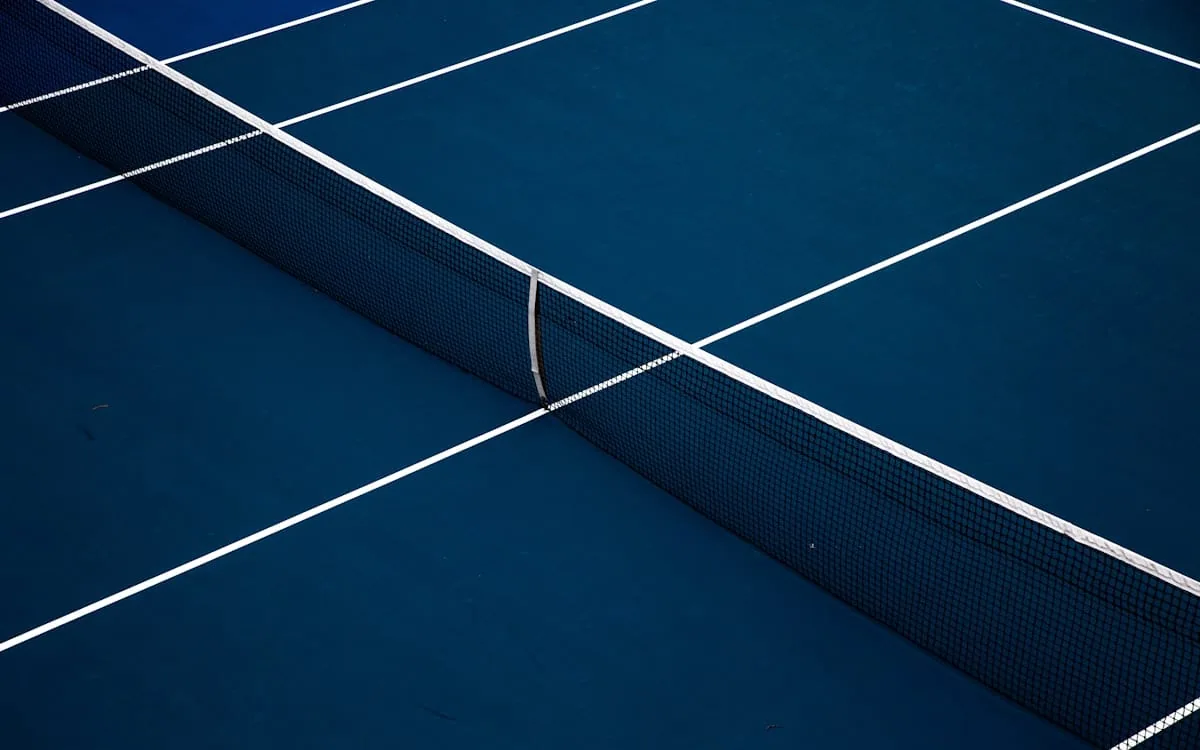
Photo: a hard court in deep blue, the net strung tight, waiting for the first match of the day.
🎾 Gear from this story
BabolatBabolat Pure DriveMirra Andreeva's racket of choiceView on Amazon →As an Amazon Associate, SUPER.TENNIS earns from qualifying purchases.